Mandy Shintani and Susan Yatabe received Japanese Canadian Legacies Society funding in 2024 for their respective projects. They both attended the September 2024 Tomoshibi Bus Tour organized by the Nikkei National Museum and Cultural Centre. The tour allowed them to meet, listen to the stories of, and interview Nikkei of many backgrounds. They visited the B.C. internment sites. With their shared interest in the history of their families, they have embarked on a series of joint presentations, starting in 2025. Audiences have responded positively to their stories of loss, resistance, survival and hope.
The Samurai in Our Closet Podcast
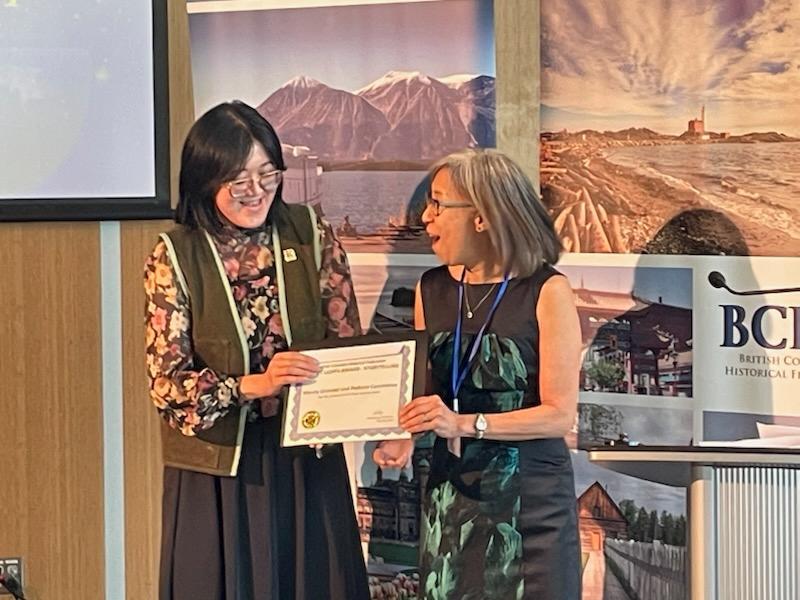
On May 30, the Bright Lights Storytelling Award was presented to “The Samurai in Our Closet” podcast by the British Columbia Historical Federation. The podcast was spearheaded by Mandy, who led its development with a committee of ten in 2024 and 2025.
The podcast leads listeners on a journey that begins with a mysterious samurai sword given to her father, George, years before Mandy’s birth. Following George’s death, Mandy learned the history not only of the sword, but that of her Japanese Canadian family, from Vancouver’s Japantown, to internment in Sandon, and her father’s experience as a Canadian intelligence officer in Southeast Asia. The podcast outlines the history of Japanese Canadians, from the arrival of the first generation in Canada, their struggles to establish themselves despite the racism that prevailed in the country, the wartime internment, post-war migration east of the Rockies, and redress. It ends with exploration of the current generation in the culture and history of their ancestors.
The podcast committee includes: Laurie Harada (script editor), Susan Yatabe (researcher) Tom Boivin, Phil Brearton, Claire Shintani, Jaye Shintani, Kim Walker and Graham Watts. The Podcast editor is Claud Tanabe.

Experiences of an Internment Camp Teacher
Susan Yatabe’s mother, Kazuko Shinobu, became a grade 3 teacher while interned in Kaslo. Her students’ artwork and photographs became the foundation of a 2025 museum exhibition at Kaslo’s Langham Museum. 83 years after the internment, Susan located thirteen of her mother’s former students (or their descendants) and documented their stories.
Susan’s father, Eiji Yatabe, was one of 148 Japanese Canadians who enlisted in the Canadian armed forces while their families were interned. Eiji and his brother Min were posted to Southeast Asia as translators with the Canadian Intelligence Corps and worked with George Shintani, investigating Japanese war crimes against allied troops.
Japanese Canadian Cultural Centre, Toronto, November 30, 2025
Vidhya Elango, Karen Suzuki, and Theressa Takasaki organized the first talk at the JCCC. Despite a snowstorm that day, a large and appreciative crowd attended. The audience was largely a multigenerational group of Nikkei families. These included:
- former internees
- several podcast committee members
- three children (participants in the podcast) of WW2 veterans who had served with the speakers’ fathers
- the daughter of an American WW2 veteran
- one of Kazuko Shinobu’s former grade 3 students
Theressa Takasaki hosted the question-and-answer session after the talk. The informal meeting after the talk, accompanied by refreshments, lasted longer than the presentations!
Canadian War Museum, Ottawa, Ontario, May 7, 2026

Meredith Sharpe of the Canadian War Museum invited Mandy and Susan to speak in the Museum’s Lebreton Gallery, a dramatic glass-walled space housing objects including armoured vehicles, military hardware and a Lancaster Bomber. An audience member noted with irony that the Parliament Buildings were visible behind the speakers as they described the wartime experiences of their parents.
The architect of the CWM had been Raymond Moriyama, whose father had been interned in the Petawawa and Angler P.O.W. camps in Ontario. The rest of the Moriyama family, including Raymond, was sent to Lemon Creek, B.C.
Minutes before the talk, Princess Margriet of the Netherlands entered the Museum, and many audience members were able to see her. This royal visit was reminiscent of Friday, May 16, 1947. Mandy’s and Susan’s fathers were returning from the Far East by ship, as their military service was ending. On that day they were in London and by chance saw the King and Queen of England.
The War Museum audience was large, supportive and highly engaged. Sachiko Okuda of the Ottawa Japanese Community Association had helped to publicize the talk to the local Nikkei community. Some in the audience had been instrumental in obtaining an official apology to Japanese Canadians from the government in 1988 and redress for the events of the Second World War. The moderator, Museum historian Andrew Burtch, hosted a question-and-answer session after the talks.
A major highlight of the evening was conveying the good news sent by Debbie Jiang the previous day: Japanese Legion Branch #9, created in 1926 in Vancouver by Great War veterans, had been forced to surrender its charter in 1942, and the issei veterans were interned. The Museum’s audience applauded enthusiastically when they learned that the Royal Canadian Legion had agreed on May 6, 2026 to reinstate the charter of Legion Branch #9.
Several people spoke to Mandy and Susan after the talk, saying that they had seen photos or mentions of their family members in the talks.
Royal Canadian Legion, Haliburton, Ontario, May 13, 2026
The May 13 talk was part of Haliburton’s highly successful Speaker Series and had been publicized for over a year by Barrie Martin and a volunteer committee. The talk was moved to a larger venue after the tickets based on the original location sold out. The larger venue was, appropriately, the Haliburton Legion, a very important community hub.
The Haliburton audience was highly interested in the presentations. Some audience members became very emotional while listening to the speakers’ stories. Many applauded when learning that Premier Mitch Hepburn of Ontario had invited Japanese Canadians from B.C. to work on his farm so they avoided internment. Mandy and Susan were very surprised to receive a standing ovation – among the three talks, this audience included the smallest share of Japanese Canadians. Just one person in the audience had experienced internment; her photo appears in a slide from Kaslo from 1944. The organizers said that this was the third talk in the Speaker Series to receive a standing ovation.
Barrie Martin led a question-and-answer session following the talks. A letter to the editor in the May 21, 2026 issue of the Highlander News (serving Haliburton County and environs) stated: “Despite the gravity of the subject matter, the evening concluded on a truly inspiring note. The Q&A session transformed into a vibrant exchange of personal stories and shared concerns, leaving the audience with a powerful sense of community, resilience and hope for a more inclusive future”.