By Lorene Oikawa, Past President
Father’s Day is one day to pay tribute to our fathers, grandfathers, and those who took on the dad role.
The father figures in our communities start with the first Japanese men to come to Canada in the 1800s who settled here and tried to fit into the various industries, farming, fishing, forestry, coal miners, millworkers, businesses like hotels, stores, restaurants, and services, and professions like law, medicine, and finance which, without franchise they would not be recognized, but they would assist the community.
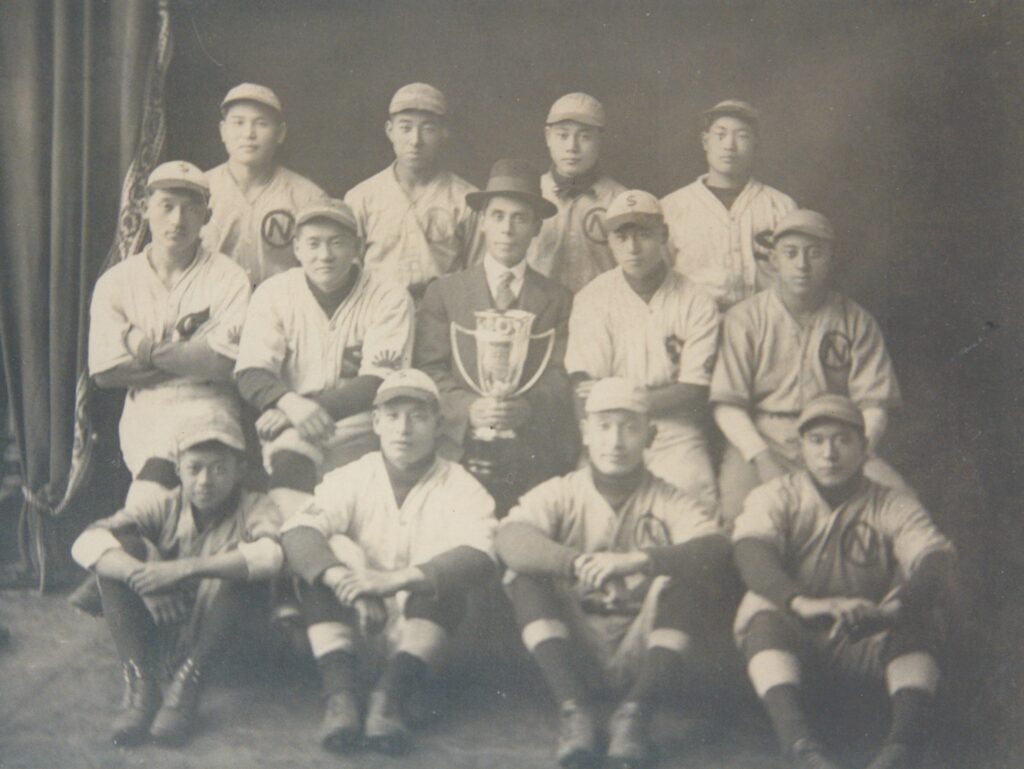
The photo of baseball players accompanying this article is of the combined Nippon and Sun baseball teams associated with the Japanese Canadian workers at Mine #1 and Mine #5 in Cumberland. They would work the mines under the most dangerous conditions and then when they could, they gave their all for baseball. In 1922 they won the Comox District Championship.
Baseball was very popular and there were good Japanese Canadian ball players in towns across the BC coast. The Vancouver Asahi were active from 1914 to 1941 and would recruit players for each season with the lure of mill jobs and the opportunity to play baseball in Vancouver. The winning and popular Asahi played their last season in 1941 because of the forced uprooting, dispossession, incarceration and exile of all 22,000 Japanese Canadians on the coast.
The other photo of the Kaslo Kendo Club was taken in 1944, a couple of years after the boys who were uprooted and sent with their families to the Kaslo Incarceration Camp. Japanese Canadians were determined that even in incarceration, their children would have education and worthwhile activities. Kendo is a modern martial art based on the ancient tradition of samurai swordship and teaches a focused mind, mental and physical coordination, and respect and honour.
We respect and honour all fathers, and those in dad roles. Thank you to Mary Kitagawa, Masako Fukawa, Sharon Minemoto, Jay Hirabayashi, and George Doi for sharing their memories.
Mary Kitagawa’s Father
My father Katsuyori Murakami was a wonderful role model for me and my siblings. He taught us what he wanted us to learn through gentle conversations. We learned how to discuss any topic because he valued our opinions. By always listening to us and letting us express our thoughts, he gave us confidence to speak up. Before the war when we
lived a normal life, we were not allowed to sit at the table until father sat down for our meals, and we were not allowed to leave the table until he stood up.
At the table, we always had a lively conversation where we had to participate in any discussions that presented itself. Everyone had to participate whether you were four or thirteen years old. Father would ask age-appropriate questions for us to ponder and to give our thoughts or ideas. He and mother also taught us to speak up for those
who could not voice their discontent. That is how we learned to speak up against injustice and not be a bystander.
Masako Fukawa’s Grandfathers
I never knew my paternal grandfather. I was 18 months old when we were separated. He was relocated to the sugar beet field of Emerson, Manitoba and I was taken to the internment camp of Greenwood. He passed away in Winnipeg before we could be reunited.
My maternal grandfather, Yokichi Ishida was our caregiver with my grandmother. He protected my brother from bullies and me from the rooster in the henhouse when I tried to collect their eggs. He was a devotee of Jodo Shinshu Buddhism. His interpretation of reincarnation was a puzzle to us as children. He would chastise us by saying “If you’re a bad person, you could come back in the next life as a bug or an insect.” After our return to Steveston, he became a caretaker of the inner temple shrine at the Steveston Otera. He filled the temple with so much smoke from the incense that some people with allergies were seen crying. He said the smoke was to alert the Buddha so that he could hear the chants of the priests and the followers.
I miss him very much.
Sharon Minemoto’s Father
My father, Terry (Moriteru) Minemoto was born on May 27, 1933 in Whonnock, BC. Like many who were born during that time, life was full of challenges. In 1941, his mother took him and his siblings to meet their grandmother in Toyoshima, Japan. While in Japan, Pearl Harbour was bombed and the course of my dad’s life was altered. My dad, his siblings and their mother were no longer welcome in Canada so they had no choice but to stay in Japan. Back in Canada, his dad was sent to an internment camp in Moose Jaw, SK where he eventually died. Toyoshima is a small island about 57km from Hiroshima, which meant my dad’s family were present when the Americans dropped the atomic bomb. My dad’s years as a teenager in Japan were difficult without his father and he had to work during the day to help support the family and attend school at night. When the Canadian government allowed Japanese Canadians to return to Canada, my dad saved up some money and made his way back home. His first job in Canada was working for John Kamimura in a sawmill near Hope, BC. There, he made many friends and from what I’ve been told, my dad was often the life of the party. He enjoyed joking around and chatting with people. During his time working as a logger, he had an accident when a tree fell on him and broke his leg. He somehow got himself in a truck and drove himself to the hospital in Vancouver. He was tough! Upon his return to the logging camp, he worked in the kitchen while his leg healed. Eventually, he found himself back in Vancouver.
From the 70s through the 90s, my dad kept a hectic work schedule to keep up with all the costs of living and the business, so he did not have time for a lot of hobbies. We didn’t have money for a lot of extras, but my dad knew to enjoy the little things in life. He got much enjoyment (and frustration!) following the Vancouver Canucks even before they were an NHL franchise. He took us to hockey games at the Pacific Coliseum a few times per season. When I was a kid and lost a tooth, my dad went to a Canucks game and got me an autographed puck and put it under my pillow “from the tooth fairy”.
Despite being a terrible singer, he loved singing along to his Japanese records on Sunday mornings which created many opportunities for my sister and I (we both became professional musicians) to roll our eyes, which made him sing even louder just to bug us.
My dad passed away of cancer on May 22, 2010, a few days short of his 77th birthday. In his final weeks in hospital we had good chats and played many games of cribbage. We saw the Canucks once again blow it in the playoffs to which he said, “Well, I guess I’m never going to see them win the cup” to which I said, “I may not either!”
Jay Hirabayashi’s Father and Grandfather
[Lorene: I met Jay Hirabayashi at a recent Japanese Canadian event and was pleased to be able to tell him how much I admire his work and his father who was an iconic civil rights activist. The following are excerpts from an article Jay wrote about his parents in 2012.]
My mother’s father, Floyd Schmoe, was a charismatic individual, a renaissance man who was a lifetime pacifist, author, sculptor, mountain guide and park naturalist on Mt. Rainier, marine biologist, and forest ecologist. He built houses for refugees in France for 14 months during World War I. He built houses in Hiroshima for four years after World War II and was later made an honorary citizen of the city. He built houses for three years in Korea after the Korean War. He was nominated three time for the Nobel Peace Prize. At the outbreak of World War II he was involved in helping Japanese Americans deal with the relocation orders to concentration camps. My father was a student at the University of Washington at the time and, drawn by the charisma of my grandfather, became a member of the Religious Society of Friends (Quakers). My father’s resistance to the curfew and relocation orders and his subsequent court battles all the way to the United States Supreme Court are well-documented and required reading in law history classes in the United States as one of the few cases where the U.S. Constitution failed to protect its citizens.
I remember my father as a patient, quiet, hard-working man who loved following sports. He was a pacifist, like my grandfather, so punishments for my not infrequent transgressions were met not with physical punishment, but with long, and I mean long—three to four hour—lectures. I would start off being sullen and angry and end up being totally ashamed and grateful by the end, that the lecture was over.
We take our parents for granted until they are gone and then we realize how rich our lives are because of their care and love for us. I will miss them for the rest of my life.
George Doi’s Father
Father had a passion for baseball, and he was very good at it. He was a pitcher. He told me that one year he averaged eleven strikeouts per game and the most strikeouts he had in a game was nineteen. (The Major League pitcher, Randy Johnson of the Arizona Diamondbacks set a record of twenty strikeouts in one game in year 2001) Dad’s speciality was a “drop” ball. Sometime in the 1950s he showed me how to throw a “drop”, and I was really surprised to see the slow-pitched ball drop suddenly, right before the plate. When I saw that, I was really impressed and had no doubt that he was an exceptional pitcher!
Except in Major leagues, ball players in those days did not get paid for playing. Instead, they were promised good jobs.
The name of the baseball team for the Number Five mining community was “Sun”, and for the Number One team, “Nippon.” As Dad lived in Number Five, he was with Sun team. Whenever the Japanese team played the Caucasians, they combined the two teams. The combined team won the championship in 1922.
Dad initially played for the Sun team. But sometime in the 1920s the Asahi team came to Cumberland to play against the Sun team., they saw him pitching. Uncle Fred told me that it was sometime after that the Asahi’s asked Dad to pitch for them.
[Lorene: My grandfather Kenichi Doi was part of the 1926 Vancouver Asahi baseball team that won the 1926 Terminal League Championship, and part of the 1922 Comox District Championship. My father Tsuyoshi Oikawa is one of the boys in the Kaslo Kendo Club photo.]